 |
h1{font-size:18px;}
Chinese traditional music
|
China is the largest and most influential
country in Southeast Asia and, together with India, is the cradle
of Eastern wisdom and philosophy. China is a very large
country (approx. 9,500,000 km22) with more than 1.4 billion inhabitants. The largest
number of Chinese are the Han (approx.
92% of the population) with slightly yellow
skin, who began to spread south and east from the Yellow River
basin around 2500 BC.
Of the minority ethnic groups, these are
the Zhuang (15.5 million), Manchu (9.8 million), Hui (8.6
million), Miao (7.4 million), Uyghur (7.2 million), Io (6.6
million), Tutsi (5.7 million), Mongols (4.8 million) and Tibetans
(4.6 million).
..History in China terithory usually begins studying from
the period of about 2100-1600 BC, when the Xia dynasty (about which almost nothing is known) supposedly ruled. The Shang dynasty continued
in the period between the 18th and 12th centuries BC. But then,
due to invasions from the west, a long period of violence,
instability and warring groups began. The first unified state was
founded after 220 BC by the Qing dynasty, which also
established the office of emperor. The Han dynasty soon
followed, which ruled successfully until 220 AD. Then another
period of chaos and strife occurred, and only in 580 was China
reunified by the Sui dynasty, followed by the Thang and Song
dynasties. In the period from the 7th to the 14th centuries,
China was probably the most advanced country in the
world in terms of culture, economy and technology (it was not known in Europe for a long time, until Marco
Polo described it). After 1271, northern
China was controlled by the Mongol leader Kublai Khan,
who became emperor. The Ming dynasty followed and then
the Manchu Qing dynasty. The feudal-imperial period
ended in 1912, when the Republic of China
was proclaimed.
..Thus, the period of more than 5,000 years of monarchy
ended and (at least formal) democracy began, the Kuomintang
political party was founded.. Three presidents then took turns (during many political disputes and skirmishes). After 1924, General Chiang Kai-shek became the
chairman of the Kuomintang, who began to control the military
forces. Then the Japanese army invaded China, during which more
than 300-400 thousand Chinese civilians, including women and
children, were murdered, mainly in the vicinity of Nanking. These
horrific war crimes (the Nanking
Massacre in December 1937) greatly damaged
China's relations with Japan. Japan was then a fascist state (and even later tried to conceal its war crimes).
..After World War II, the Kuomintang split into two
groups: the nationalist group led by Chiang Kai-shek and the
communist group led by Mao Zedong. In the civil war of 1946-49,
the communists won and declared the People's Republic of
China, with Mao Zedong as its president. The defeated
nationalist faction also declared the Republic of China with
Chiang Kai-shek as its president and moved to the island of Taiwan.
Since then, there has been a senseless hostility between the
governments of Taiwan and mainland China.
..I have outlined the political history of China here only
very briefly (without mentioning the now
irrelevant names of temporary emperors and presidents), rather in a shorthand expressions, as it has no direct
relation to Chinese classical music.
Chinese traditional music *) is characterized
by its sophistication , softness
, composure and poetic tuning ,
magical genre images of nature with sound-painting effects. It
developed over the centuries (even millennia) both in the
residences of Chinese rulers and Confucian
officials, and was influenced by Buddhist and Taoist
sages and poets **) meditating in the bosom of beautiful
Chinese nature. For centuries, this music served as an instrument
of intimate meditation for followers of Buddhism and Taoism - in
harmony with poetry, painting and calligraphy (for some also with drinking wine ...) .
*) Classical Chinese music is mainly meant
here. Chinese folk (ethnic) music is usually completely different
- especially very diverse, depending on the geographical area or
national origin. From Mongolian-type bifonic throats in the
north, through Tibetan music in the northwest, Turkmen-Arabic
music in the west, to gamelans in South Asia.
**) Early philosophical Taoism did not promote the music
(considered it a disturbing phenomenon), but later not only
Confucian but also Taoist scholars used the Chinese guitar, for
example, as an uplifting tool for meditation and connection with
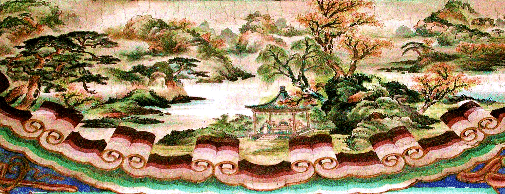
nature. It is also depicted in a number of ancient Chinese
landscape paintings, where a lone philosopher meditates and plays
a string instrument in a landscape with misty mountains or a
lake.
This is the source of some motifs
imitating the sounds of nature and also poetic
names of compositions ***) - eg "Moon reflected on
the surface of the lake", "Ducks in the reeds",
"Moon night on the spring river", "Lanterns and
the moon competing in glitter", "Autumn moon over the
Chan Palace "," The scent of plum blossoms in the cold
of the beginning of spring "," Dance in the cloak of
the rainbow "," The clang of jade belts of the
immortals spreading through the sky "," Departure from
a world without grief ", ... There are common symbolic
features with ancient Chinese poetry and painting , especially
with landscape painting.
***) It should be noted, however, that
(perhaps to an even greater extent than European music) there is
no direct relationship between the title of a composition and the
music itself. The same melody can evoke different (even
conflicting) moods, feelings or images, depending on the context
and subjective perception of the listeners and musicians. After
all, the same melody is sometimes given under completely
different names.
..Buddhism and the influences of traditional Chinese music
have spread throughout virtually Southeast Asia, including the
islands of Indonesia.
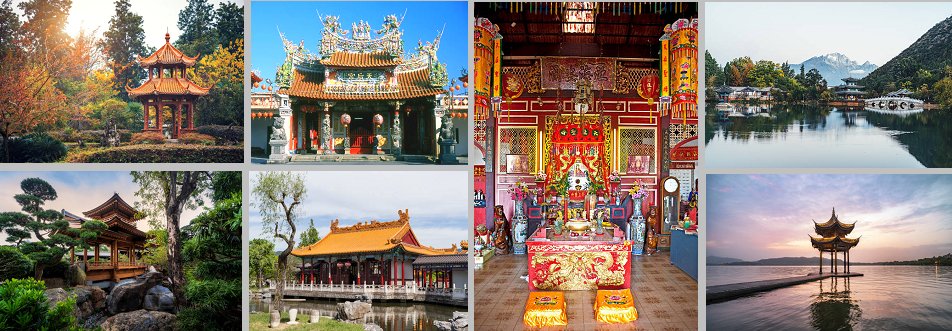
The pictures capture a glimpse of some aspects of architecture
and nature in China :
.... 
..Chinese classical music sings about nature and the
seasons, about high mountains, flowing waters of rivers and calm
waters of lakes, singing of birds. Chinese music blows a gentle
spring breeze between the branches of trees, the roar of
waterfalls, streams swinging flowers on their banks. Dreamy
voices of summer, the depth of a clear night sky full of stars,
the moon reflected in the surface of lakes or in drops of dewy
grass, falling snowflakes. There is a gentle rustling of rain and
the roar of the storm, when "dragons roam the
lightning".
Master Chinese music, despite its subtlety, resounds the whole
symphony in our feelings. With the magical touch of beauty, the
hidden strings of our being are awakened. Long-forgotten
childhood memories return to us with a new charm. The soul speaks
to the soul ...
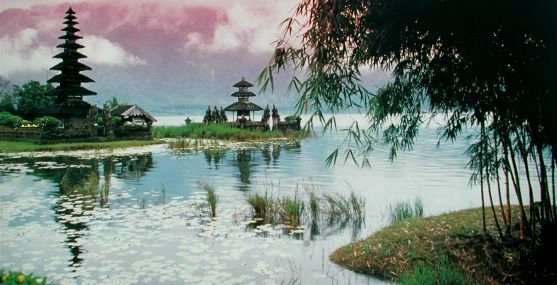 |
A small Buddhist monastery of the southern type |
Chinese musical instruments
The most commonly used musical instruments in
traditional Chinese music are:
Flutes
:
Ti - transverse bamboo flute ...
Hsiao - bamboo flute about 56 cm long, with 6
holes on the top and one on the bottom tent.
Kchou - chin - the smallest
flute (whistle), only about 8 cm long with 3 holes, on which
virtuoso Chinese players can masterfully imitate especially the
singing of birds.
Hsuin - an ancient flute ("ocarina")
made of burnt clay with 6 holes (one at the top, three at the
front and two at the back), decorated on the surface with Chinese
ornaments, mostly dragons.
String instruments
:
Er - chu- Chinese
"violin" with a hollow cylindrical body and a long neck
on which two strings are stretched.
Chung - chu - Chinese
"viola", similar to er-chu, but larger and with deeper
tones; it also occurs in a variant called Nan-chu
.
Pchi - pcha - classical Chinese
lute with 4 strings and 23-25 ??frets.
Qin - an ancient 7-string fretless zither, an
instrument of intimate meditation by Chinese philosophers.
Ku - Zheng - ancient zither
long table about 1,5metru. On the longitudinal body (made of
sandalwood and sycamore wood) the strings are stretched over the
moving locusts. It is played with picks attached to the fingers.
The pitch is affected by pressing the string behind the bridge.
(Note: the Japanese Koto
evolved from the Ku-cheng zither ).
| The most common traditional Chinese musical instruments : |
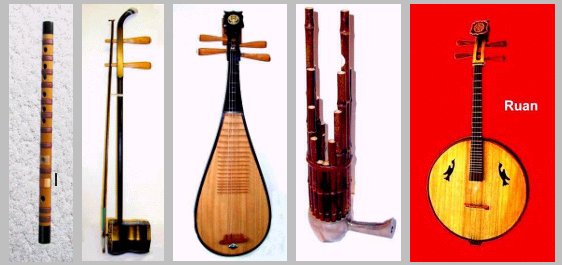 |
| Flute .... violin Er-hu .. lute Pchi-pcha .... organ Sheng ... "lunar" lute Ruan |
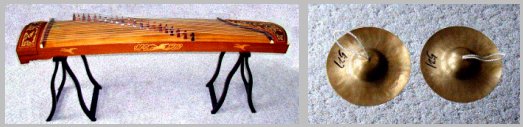 |
| .. Ancient table zither Ku-cheng ......................... .......... Cymbals |
Other instruments :
Sheng - blowing oral "organ".
Suo-na - an ancient Chinese shalmaj (came to
China from Central Asia about 800 years ago), a sliced
??instrument (similar to an oboe) with a piercing screaming tone,
suitable for imitating the voices of birds.
Pa-wu - a South Chinese sliced (shalmay)
instrument made of gourd and bamboo.
Yangzhou - a Chinese cymbal from Persia, its
strings resounding with the blows of wooden mallets.
Bells - hanging ritual bells in Buddhist
monasteries, gongs ....
Drums - one-sided and two-sided ....
Cymbals - brass cymbals large and small .....
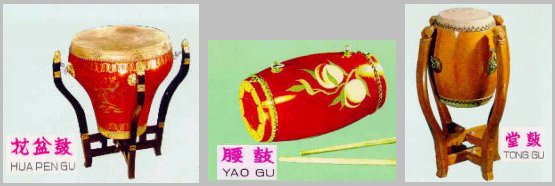 |
| Some types of drums used in traditional Chinese music |
Note: Traditional Chinese musical instruments have penetrated, in addition to Japan, into all the countries of Southeast Asia, where they have become a starting point for the instrumental equipment of local traditional music. We can mention for example. Zither Kyageum (similar to Chinese zither Zheng and Japanese Koto ) dvoustrunnné violin Haegeum (originated from Chinese Er-chu ), oboe wafer tool P'iri or drums puck and Cang .
 |
 |
Acknowledgements: I would like to thank Mgr. Jan Chmelarcík for a number of important information, comments and ideas. For more serious interested parties, I can recommend, for example, his work on the Ku-Cheng zither. |
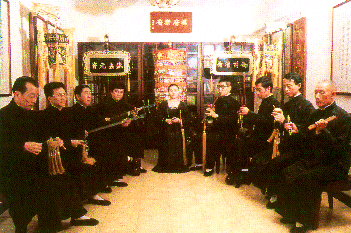
Chinese orchestra of traditional instruments |
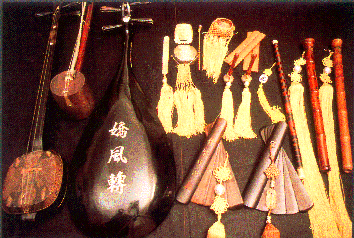
Some traditional Chinese musical instruments |
 |
Sound library : |  |
Traditional Chinese Music -
Most Important Songs
Starring: Chinese National Radio Orchestra. Er-hu solo: Jiang
Jang Hua
Traditional music from Li-Jiang province
Starring: Da-Yang city orchestra
Moon over the lake -
lyrical ancient Chinese music
Fine ancient tuning -
the oldest Chinese compositions
..........
Lanterns and the moon in glitter - Chinese lute compositions
Pchich lute solo: Wu Man
Fan-Baj - liturgical
music of Buddhist monks from Shanghai
Psalmodic morning songs accompanied by bronze bells, drums, gongs
and cymbals
Buddhist music from northern China 1, 2
Accompanied by zither , gongs, drums and organ Sheng.
Musicologist: Tien Ching
China - Spirit and Wisdom
China - Many Faces
cross section of classical and folk Chinese music. Recorded by:
Shi Zeng
Nan - kuan - palace
music of ancient China
Starring: Chan-than
Qin ensemble - zither of Chinese philosophers
Starring: Tai
Xia -lien Virtuosity of Chinese lute - compositions
for traditional Chinese lute Pchich
Starring: Lin Shicheng and Kao Chung
Chinese instrumental heritage - the oldest and newest Chinese instrumental
compositions
Cheng: Liang Tsai-Ping and Liang Ming-Shih, Sheng: Liang
Ming-Yueh, Hsiao: Wong Chen-Hwa, Nan-Hu: Lin Pei
P'ansori - Korean
vocal and instrumental music
Cast: Kim So-hee - vocals, Kim Yoon-duk, Chi Young-hee, Sung
Keum-yun - puck, p'iri, chango, kyageum, haegeum
...........
The list of other compositions of traditional Chinese
music will be gradually added here. However, some of these songs
were recorded occasionally from older media or from the radio, so
in addition to a somewhat reduced technical quality, I did not
have the names and details of interpretation - I apologize for
the incompleteness, or distorted the names...
| Music: | Indian | Chinese | Tibetan | Japanese | Orthodox | Catholic | Islamic |
| Anthropic principle or cosmic God | Gravity, black holes | Science and faith | |||||
| AstroNuclPhysics ® Nuclear Physics - Astrophysics - Cosmology - Philosophy | |||||||