 |
h1{font-size:18px;}
Japanese traditional music
|
The Japanese islands in the Pacific Ocean, near
the northeastern coast in the far east of the Asian continent,
occupy an area of about 378 thousand km2 and are home to 123.5 million people. The main islands
are - from south to north - Kyushu (35,640 km2), Shikoku (18,800 km2), Honshu
(230,500 km2), Hokkaido (77,900 km2). Japanese society is ethnically and culturally quite
homogeneous, 97.4% are Japanese, about 2 million Ryukyus on the
southern islands, several tens of thousands of Ainu, mainly in
the Hokkaido region. Small minorities are also Chinese, Koreans,
Filipinos.
The oldest
archaeological finds of ceramics indicate that the Japanese
islands were settled around 30,000 years BC, some of whom
probably came from Southeast Asia. Around 300 BC, rice
cultivation and metalworking began to develop. Around 500 AD,
Buddhism and Chinese writing began to penetrate from the Asian
continent to Japan, which was adapted to the Japanese language.
.... ...... .....
The history of Japan
before and during World War II was very shameful. The Japanese
army invaded China, during which more than 300-400 thousand
civilian Chinese citizens, including women and children, were
murdered, mainly in the vicinity of Nanking. These terrible war
crimes (the Nanking Massacre in
December 1937) greatly damaged China's
relations with Japan. At that time, Japan was a fascist state (it collaborated with Hitler's Germany) and even later tried to conceal its war crimes. The
fascist Japanese Emperor Hirohito remained in office after the
war, until his death in 1989. Only then his successors Akihito
and Naruhito distanced themselves from Japanese war crimes and
publicly apologized for Japan's role in World War II.
On December 7, 1941,
Japan imprudently launched a major attack on the American naval
base at Pearl Harbor in the Hawaiian Islands, killing
more than 2,400 sailors. The attack resulted in the United States
entering World War II and declaring war on Japan. It brought
enormous losses to Japan and misery to hundreds of thousands of
its citizens. This resulted in a great tragedy at the end of the
war, when the USA dropped two nuclear bombs ("atomic" - JadRadFyzika3.htm#JadernaExploze) on the Japanese cities of Hiroshima
and Nagasaki on August 6 and 9, 2045, which killed more
than 200,000 people, mostly civilians. On August 14, Emperor
Hirohito declared the surrender of Japan. However, this surrender
was not caused by the atomic bombing, but by the entry of the
USSR into the war and the impending invasion of Japan. In the
post-war period, Hiroshima and Nagasaki are mostly no longer
viewed as a legitimate act of war, but as an unnecessary tragedy
and a war crime by the USA (and
perhaps also as a greatly exaggerated revenge for Pearl
Harbor..?..).
The character of Japanese traditional music,
originally based on the traditions of Shintoism
, was largely shaped by its close connection with Zen
Buddhism - the Japanese version of Buddhism (see " Buddhism, Hinduism, Taoism "). Buddhism came to Japan
from China in the 6th century in the form of the Chinese
Buddhist direction , partially enriched with elements of Taoism
. Domesticated in Japan as Zen Buddhism, it soon prevailed over
the original domestic Shintoism, which, however, did not
displace, but with which it coexisted closely
for centuries to this day. Buddhist teachings have become one of
the fundamental factors shaping Japanese culture. In addition to
music, we can mention austere sand and stoneZen gardens
, teahouses and tea ceremonies (which are also
religious rituals), calligraphy, short haiku
poems.
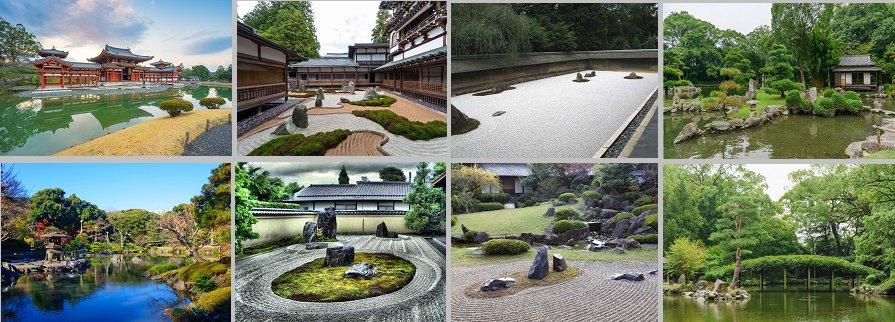
Note: For our
Japanese-style garden, see " Japanese
Garden ".
Japanese
tea ceremony
Zen Buddhism is the source of a remarkable, specifically Japanese
phenomenon - the tea ceremony . Ceremonious own
way tea is called anoju ( chanoyu
) - " hot water for tea ." Sad or
chado (which means " tea path
") is then the collective name for the whole system of
traditional Japanese tea culture. The origins of the tea ceremony
go back to the realm of tea, to ancient China.
In the 12th century. some Japanese monks, especially the Zen
master Eisais, went to China to study Buddhist teachings and
brought tea tree seeds to Japan. Tea gardens were initially
established, especially at Zen monasteries. In the 15th century.
The development of the tea ceremony and its transformation into a
specifically Japanese style (in the spirit of wabi ) was
significantly due to the prominent tea master Sen no Rikyu.
This ceremonial drinking of
tea, or rather a tea meeting (tea is a means
here, not a purpose and a goal) is held in small " tea
houses " surrounded by a sober
Japanese-style rodi garden , with stepping stones. In
front of the tea room is a stylish stone tsukubai well
with a bamboo ladle ( hishaku), where incoming tea party
participants wash their hands (see " Japanese
Garden ") . The entrance to the teahouse is usually lowered and
relatively narrow - it is said that this is so that the samurai
have to lay down their swords if they want to pass; in any case,
the inclination at the entrance is to express respect and
humility. Moderately dressed guests without jewelery *) then
enter a very simply furnished room with rice mats on the floor,
tea tools and a drawing or calligraphy hanging on the wall.
*) In the spirit of the essentially
democratic principle, it is not possible to know who is rich or
poor; during the tea ceremony, everyone is equal in the spirit of
wabi - voluntary and noble simplicity,
modesty and sobriety.
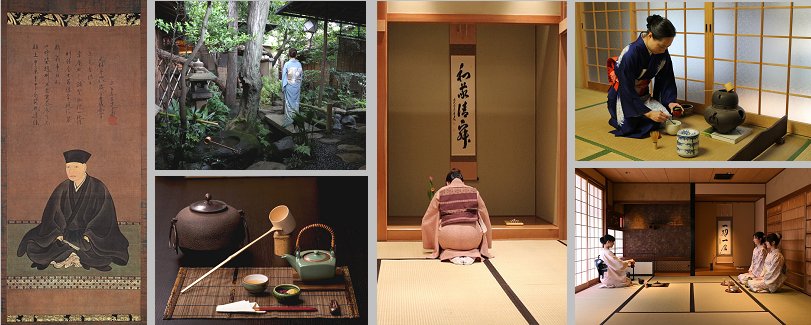
The house for making and drinking tea is
called a timer (tea house), taian (tea hut) or
soan (grass shack). The tea room is also called
sukija - the hut of "emptiness", where
everything is arranged only in a hint, everyone, according to
their imagination, completes a certain idea in their interior. A
significant place in a traditional Japanese tea
room is the so-called tokonoma - a
small room or just a niche in the wall, where scrolls with
paintings or calligraphy, flowers arranged in the style of
ikebana , bonsai and possibly other decorative accessories.
The decoration in the tocone is adapted to the time of
year and the style of a specific tea meeting.
The tea ceremony itself excels
in simplicity and modesty - in silence, in which
a sound of swirling and bubbling water begins to be heard in a
kettle over charcoal, which the Japanese compare to the whistling
of the wind in pine trees or to the murmur of a waterfall. In the
traditional highly stylized tea ceremony, it is customary to use green
tea (usually a high-quality Gyokuro variety), ground to
a powder, which is whipped with brushes made of chopped bamboo
after pouring hot water.
The philosophical side of the
tea ceremony is based on four principles: Wa
- harmony, Kei - respect, Sei
- purity, Jaku - calmed mind
; Elements of Taoism also leave their mark here. The aesthetic
side combines the concept of wabi-sabi (see " Buddhism,
Hinduism, Taoism").
Styles of traditional
Japanese music
As in China and other Eastern countries, in Japan we encounter a
remarkable phenomenon: very old and newer musical styles coexist
here and are constantly practiced to this day .
Note: This situation is completely
different from the development of classical European music, where
the new musical style usually very quickly obscured and covered
the older style, until it finally replaced it and pushed it into
oblivion; it is only in recent decades that with the purposeful
efforts of musicologists and early music lovers, they have once
again operated older musical styles in " historically
informed " interpretation.
In general, Japanese
traditional music has very different harmonic and rhythmic
principles than European music, so at first listening it sounds
very unusual to us. It is necessary to "listen" to it
repeatedly before it starts to address us...
We will
briefly mention some of the most common styles of Japanese
traditional music :
A common feature of most pieces of traditional
Japanese music is its Zen-Buddhist sobriety ,
freedom from external effects, economy , concentration
- sometimes only in one appropriately colored tone recognized at
an opportune moment ( "Buddhahood of a single tone"
) ...
Now it is very popular in Japan
even the European classical music, including ours (Smetana, Dvo
k, Jan ek, ...). We have a big debt in this regard: classical
Japanese music is practically unknown to us - apart from a narrow
circle of serious applicants.
Japanese musical instruments
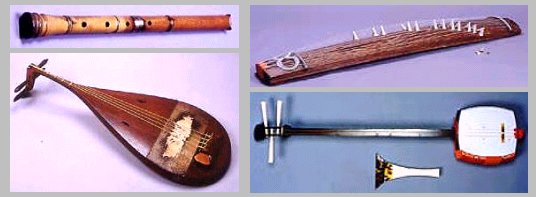
Shakuhachi -
a symbol of Japanese traditional music of meditation focus has
become shakuhachi - a Japanese bamboo flute
(length "foot 8 inches" = 54.5 cm) with five tone
holes, 4 for the fingers in the front, one for the thumb in the
back. Shakuhachi originally not serve as a musical instrument,
but as a means of liturgical breathing exercises
and meditation breath ( Shui Zen ) monk Fuke sect,
called to someone - the monks ' nothingness
'. The shakuhachi concert game gradually evolved from the fact
that poor monks earned their living by playing shakuhachi.
There are basically two styles of playing
the shakuhachi - the fuk style based on
the original style in the spirit of Sujzen (characterized by a
characteristic hissing blow at the beginning after the breath -
the sound ideal is "the rustle of the wind in a bamboo
grove" ) and a more sophisticated kinko
style emphasizing the musical side with a thoughtful melody.
In addition to shakuhachi, other related
bamboo flutes are used in Japanese traditional music. The
ancestor of the shakuhachi is the Donshon flute
. Jininas flutes are usually longer (some types
reach a length of up to 90 cm), but a simpler design than
shakuhachi. Flutes of type Ni Saku having
different lengths, e.g. Ni Saku Yon Sun measured
75 cm, Ni Saku Ha Sun length is 84 cm.
Note: Our ethnomuzikolg and
composer Vlastislav Matoušek is an
excellent virtuoso on shakuhachi and at the same time a dedicated
expert in Japanese music .
Koto - table
zither (developed from the Chinese zither Kucheng
) with 13 strings with sliding locusts. The
strings resound with the strings strung on the fingers of the
right hand, while the left hand compresses the strings - changing
the pitch, creating a vibrato and other sound effects (such as
"scratching the strings").
Biwa - a Japanese pear-shaped lute with 4
strings, with a vertically curved tuning end (developed from the Chinese lute Pipa ) . The strings resound with a strum.
Shamisen (also called sangen ) - a long-necked strumming lute with 3
strings, resounding with a large pick (the
body is sometimes covered with cat skin) .
Shamisen is rarely used solo, but often forms a "trio"
with flute and kitten. Most often we can hear it as an
accompanying instrument to the traditional Kabuki theater.
Sho - oral organ (developed from the
Chinese Sheng organ ) .
| Some traditional Japanese musical instruments: | |
| Shakuhachi flute | table zither Koto |
 |
|
| lute Biwa | 3-string Shamisen |
In Japanese music, especially ritual, percussion
instruments are often used , the most important of which
are drums, often referred to collectively as Taiko:
Taiko - double-sided drums of various sizes (rather larger
dimensions), with cowhide or horse skin membranes, placed on
suitable stands. Depending on the size and location, we can
mention eg Nagado-daiko , Hira-daiko
(it is hung in a stand), Okedo-daiko , Odaiko
or Ondeko (the largest drums, they have a
diameter of up to 2 meters!).
Note: Drumming on large Japanese drums has recently become very
popular among young people not only in Japan. Over the years,
dozens of Taiko-style drummers have been formed around the world,
especially in the United States. Drumming is sometimes performed
in a direct "devilish" rhythm!
| Some traditional Japanese percussion instruments: | ||||||||||
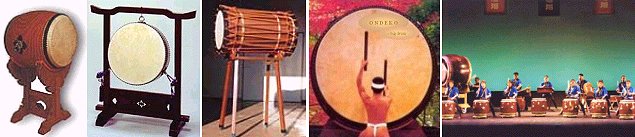 |
||||||||||
| Nagado-daiko Hira-daiko Okedo-daiko Ondeko A set of Taiko style drummers |
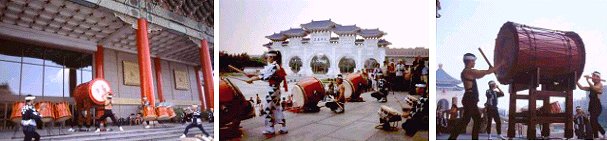 |
| Taiko drums are a common part of Japanese ceremonies |
 |
The sound library: |  |
Satsuma - heroic and
mysterious stories "Kaidan" from ancient Japan
Sings and plays biwu: Kinshi Tsuruta
Shomyo - liturgical
singing of Buddhist monks
1st, 2nd, 3rd
Komuso - monks of
nothingness
Meditation with shakuhachi
Bukagu-Ho-e - traditional
Japanese music of Buddhist monasteries
Matsuriza - sacred drums
Taiko
Starring: ensemble Vadaiko
Kagura - ritual drums
Ondeko (up to 2 meters in diameter)
Starring: ensemble Ondekoza
Calligraphy - traditional compositions for
shakuhachi
Plays: V.Matoušek
Concerto for 2 flutes of shakuhachi
Cast: ........
Shakuhachi with sounds from nature
Starring: R.Lee
Japanese traditional instrumental & vocal
music - shakuhachi, biwa, koto, shamisen
Cast: Keiko Nosaka - koto, Sachiko Miyamoto - koto, Ayako Handa -
biwa + singing , Kohachiro Miyata - shakuhachi, Horokazu Sigiura
- bells. Dir .: Minoru Miki
Yamato Ito-take - traditional compositions
for shakuhachi, koto and shamisen
Starring: Aiko Hasegawa - koto, Kikuto Satoh -
shamisen, Richard Stagg - shakuhachi
Zen Spirit - shakuhachi with sounds from
nature Starring: R.Hiebinger - shakuhachi Kabuki
- music for traditional Japanese theater Starring:
Ensemble Nipponia
Hogaku -
spirited drums of Japanese agricultural and religious
rituals
Starring: Oedo Sukeroku Taiko Ensemble, Directed by: Seido
Kobayashi
KODO: Ubu - Suna - Japanese Taiko-style
drums
Starring Kodo from the Japanese island of Sado.
................ ....
The list of other recordings of Japanese music that I have in the
library will be gradually supplemented (data on titles and
performers is sometimes difficult to obtain, I apologize for the
incompleteness).
| Music: | Indian | Chinese | Tibetan | Japanese | Orthodox | Catholic | Islamic |
| Anthropic principle or cosmic God | Gravity, black holes | Science and faith | |||||
| AstroNuclPhysics Nuclear Physics - Astrophysics - Cosmology - Philosophy | |||||||