 |
Tibetan traditional music
|
Tibet is located
on the high mountain plateau of the Himalayas, its history and
social development are largely determined by the neighborhood of
the large countries of Mongolia, India and China. The ancient
ancestors of today's inhabitants of Tibet, in the period around
the 3rd century BC from the steppes of Central Asia, from the
region of Mongolia, began to penetrate the Himalayan plateau,
later they reached Nepal and northwestern India. The oldest
legend says that perhaps in the 6th century a divine descendant
descended from heaven along a sacred cord, who was accepted as
the first king of Tibet and the Bön religion was established.
The first traces of Buddhism
penetrated from India to Tibet as early as the 6th century, they
were politically promoted by King Songtsän Gampo and
subsequently Thisong Decän. The Indian yogi Padmasandhala
was invited to Tibet, who traveled through Tibet and taught the
inhabitants Buddhism, founded the first Samjä monastery. He thus
laid the ideological foundation of Tibetan Buddhism. The real
influence and development of Tibetan Buddhism began only in the
11th century, in synthesis with elements of earlier shamanic and
animistic traditions. In 1578, the Tibetan king Sönam Gyamtsö
held talks with the Mongolian emperor Altakhan, who granted him
the title "Dalai" (the Mongolian name for the ocean).
This created the institution of the Dalai Lama
as the religious and political leader of Tibet.
All cultural (and often also
social and political) life in Tibet was
then shaped for many centuries under the influence of specific Tibetan
Buddhism, sometimes called Lamaism. The
Lama is a Tibetan spiritual teacher and master, and the Dalai
Lama is also a leader in a political sense.
Chinese influence in
Tibet
In history, Tibet has alternately found itself under the
influence of China, India, Mongolia and other surrounding
countries. The influence of China has always been dominant, even
during the periods of independence of Tibet. In the 20th century,
Chinese influence in Tibet significantly increased, especially in
the period after 1950, when China concluded an agreement with the
Tibetan government on its incorporation as an autonomous region.
In addition to temporary disputes and political problems of the
time (which have already subsided and are
now not relevant for us), this brought
significant positive aspects :
- The abolition of feudalism , which
until then had survived in Tibet and kept many people, especially
in the countryside, in subordination, poverty and ignorance (some even in slavery ).
- Equality of women, which used to be the
most oppressed group of Tibetans.
- Land reform of the existing feudal,
large-scale and monastic ownership of the land, which was made
available to farmers for cultivation.
- Establishment of public education ,
instead of one-sided, false and backward monastic education.
Monastic education has been preserved only for religious
education, especially of monks.
After overcoming the distortions of China's
"cultural revolution", these positive aspects
became prevalent and led to a substantial improvement
in lifeordinary Tibetans. Let us believe that friendly
and mutually enriching relations between China and Tibet will
prevail and that progress will continue in the future in
preserving and developing the true spiritual values and
wisdom of Tibet ..! ..
Briefly summarized: A much better life has been
established in Tibet than during the time of the feudal Dalai
Lama and thousands of monkish parasites. The current
Dalai Lama (T.Gyamtsho) lives in exile in India, but has
basically progressive views.
Note:
In 1959, an armed uprising broke out in Tibet
- a civil war, in which the former "elites" tried to
return to the old order of their rule. It was provoked by the
secret services of the Western powers, who planned to establish
missile military bases on the strategically advantageous Tibetan
plateau, which would - in the spirit of the Cold War - militarily
control the entire large area of ??Southeast Asia. This failed,
Chinese soldiers were sent there and together with the Tibetans
defeated the uprising.
It should be emphasized that the relationship
between China and Tibet is greatly influenced in our awareness by
the gross political distortions by the Western
mass media (ours have added
rectoscopically); in reality it is different,
it is all more complicated..!.. I am aware that these political
circumstances do not belong to our brief discussion of Tibetan
music (after all, I am personally
apolitical, I emphasize only the ethical and
philosophical side). With
apologies, I mention them here only in the interest of
objectivity - to at least partially correct the false ideas and
opinions widespread in our country.
Tibetan Buddhism is a complex
combination of Mahayana and Indian tantra
*), which gives it a highly ritualized, mystical and esoteric
character. Tibetan Buddhism has a number of sects, the main of
which are four: minkmapa ("old school" founded
in the 8th century), kagjupa (meditative school, founded
in the 11th century), sakjapa (until the 15th century), gelukpa
(The religious school of "yellow hats", founded at the
beginning of the 15th century, has been the dominant direction
since the 17th century; the Dalai Lama is also recruited from
it).
*) The oldest texts of Indian
tantraaccording to legend, they arose from the dialogues
of the god Shiva with his wife Devi. The tantric system, which
then complemented and expanded between the 5th and 10th
centuries, contains elements of divine cult, fertility rites,
magic, shamanism, sexual practices. Tantric yoga emphasizes the
role of psychosomatic speculation - the concept of chakras
- energy centers in the human body (mostly along the spine),
"sublimation" or "transcendence" of sexual
energy during orgasm into "higher realms of
consciousness", which should lead to true culmination and
liberating experience.
Some tantric elements have been adopted into Mahayana
Buddhism , especially in northern India. In India, then
in the 12th century. Buddhism was pushed out and gradually
integrated into Hinduism - the Buddha was then interpreted as the
avatar of the god Vishna. However, Tantric Buddhism has been
preserved and further developed in Tibet.
Also Tibetan traditional
music developed in close liaison with the Tibetan
variety of Buddhism - Lamaism *). This religious direction, more
than any other direction of Buddhism, is oriented towards monastic
life in monasteries with many rituals
with a specific color (such as the Mahakala ritual ).
*) This refers to spiritually
oriented Tibetan music. Tibetan folk (ethnic)
music is completely different, its roots are not in India, it is
more similar to the music of Central Asia and Mongolia.
There are many Lamaist monasteries in Tibet (even every village or settlement tried to establish its
own monastery where their boys could be educated). In history, around 10,000 monasteries have been built
since the 8th century, of which about 1,400 have survived to the
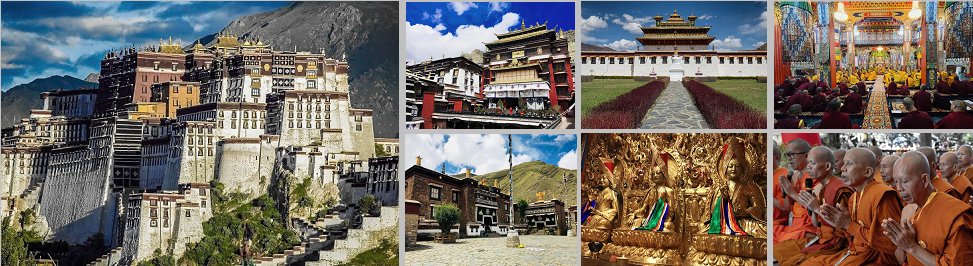
present day. The largest is the Potala Palace (pictured left) in the capital of Lhasa,
Tibet Autonomous Region, which, however, serves primarily as an
administrative center. There are around 20 other large
monasteries. More than 45,000 monks now live in Tibet.
Historically, there were up to 600,000 monks.
The endless chanting of mantras
by Tibetan monks takes place in a monotonous "grunting"
voice with deep vibrations, which, however, has
its melody and mystical impact. There is a peculiar peculiarity
in the Tibetan vocal expression - an aliquot of biphonic
throat singing . By a special setting of the tongue and
lips, it is possible to achieve that when the nasal tone is
emitted, some aliquot tones of the basic sung tone are amplified
to such an extent that we hear two tones
at the same time from the mouth of one singer. In addition to
Tibet, biphonic singing is also practiced in Mongolia and in the
adjacent area of Tuva and Altai.
Critical note: the splendor
and misery of Tibetan monasteries
For the sake of objectivity, we should not idealize life in
Tibetan monasteries (and in traditional Tibetan theocratic-feudal
society in general) too much! Enlightened philosophers and
spiritual teachers made up only a very small part of it. Most
monks were poorly educated, their mental horizon did not
go much beyond the mechanical learning of mantras, which they
constantly repeat over and over, without deeper understanding.
The motivation for monastic life was not spiritual for most, but
rather the possibility of an easier life in a poor country. The
number of monasteries and monks in them was often excessive
(up to a quarter of the total male
population), so there were not enough
people to work to ensure the standard of living and
development in Tibet.
In communities with a large number of monks, negative phenomena
such as bullying and sexual abuse also manifested themselves....
Tibetan
musical instruments
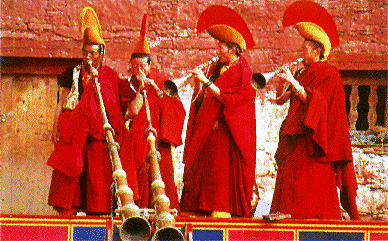
The religious ceremonies of Tibetan monks are accompanied by
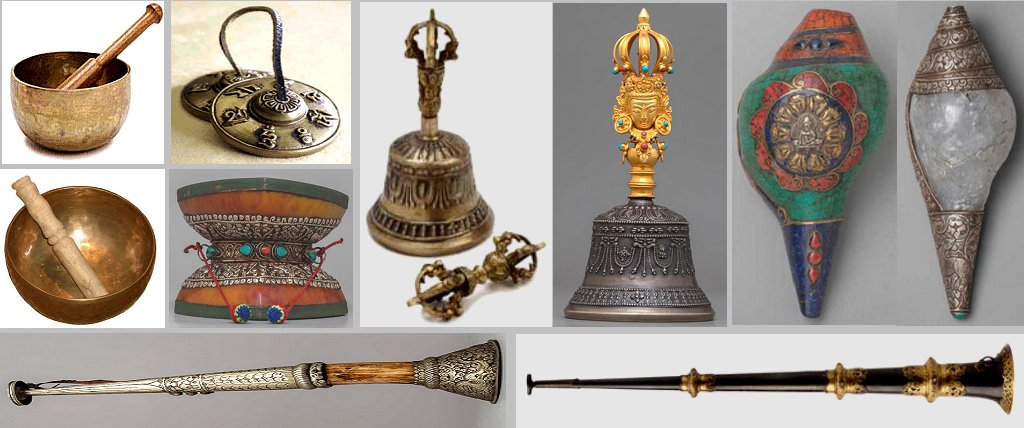
sounds and music on specific instruments. The most simple are Tibetan
bowls, which are bronze bowls of various sizes (originally also used as a dining bowl), which resound with the blow of a mallet, after which
the tone of the rod can be maintained by rotating the mallet
around the perimeter of the bowl. Then there are various gongs
(often of considerable size), bells , Relmo cymbals
, drums (such as the Nga frame drum ). Often
also used shells whose protracted shouting in
Munich to pose convened ceremonies. The powerful sound is made by
the long Tibetan ovens - horns
of Rang dung, which are around 2 meters long, sometimes
up to 3 m.
 |
Sound library : |  |
Buddhist Meditation
Sings: Lama Card
Vibration of Peace - Meditation
Music for Tibetan Flute Starring:
Tibetan meditation - relaxation music based on Tibetan
ceremonies Uploaded by: Phil Thornthon
Tibetan Buddhism - .................. ....
Dhama Suna - traditional Tibetan music
"gar"
..........
..................... a number of other titles will be added.
........
| Music: | Indian | Chinese | Tibetan | Japanese | Orthodox | Catholic | Islamic |
| Anthropic principle or cosmic God | Gravity, black holes | Science and faith | |||||
| AstroNuclPhysics ® Nuclear Physics - Astrophysics - Cosmology - Philosophy | |||||||